Original Joy
After a forty year absence, Inari Kiuru returned to her early childhood home in Lappeenranta, Finland. She stayed for several months in 2024 and again in 2025. This small South Karelian town was the place of her earliest sensorial enmeshments with forests, lakes, and seasons—formative experiences which have resonated in her to this day. In re-encountering this significant place as an adult and mother, and being immersed in its landscapes and the cultural community of her early years, she felt a deepening of connection with her lineage, and a re-uniting with the free, playful and sensorial nature of her childhood self. This followed decades of deep personal struggle with her direction and place as an artist, and was a turning point that unlocked a series of profound transformations: an embodied realisation that the freedom and joy of direct engagement with the natural world is at the core of her being as a person and an artist, and through her connection with the Finnish arts community, an illumination of where her deep artistic callings come from—that her longing to communicate the phenomena of the changing seasons and light, something deeply embedded within the Finnish psyche, is her heritage, and a gift to fully embrace.
In the artworks that have evolved from these insights and transformations, I see a channeling of something of great importance to Inari, an energy to pass on through material, through an instinctive physicality and a sharply tuned and very sensitive eye. Is it beauty? Yes, but it is also an expression of connection with the energies of the natural world, as they have spoken to and passed into her. The recognition that she is synonymous with her sensorial experience has given Inari a passionate volition to make artwork directly from this place—a state of being she terms ‘Original Joy’.
The world has ways of communicating with us that we cannot always translate into words. Many thinkers, writers and artists have discussed how the limits of language circumscribe limits to our descriptions of being, though poetry has a way of penetrating the multidimensional character of lived experience in words. As the writer Maria Popova articulates ‘(poetry) shines a sidewise gleam on the invisible and unnameable regions of being where the truest truths dwell’ (1). The works in ‘Original Joy’ contain a conceptual poetry, but also penetrate the character of lived experience in a different way—by engaging the senses directly through material. In synthesising texture, light, colour, form and sound in unique and evocative ways, they provoke a new lived experience in their encounter. Though less called on in our visually dominant world these days, our sense of touch is arguably the most intimate, powerful and affective interface between ourselves and our environment. Inari has embraced her closeness to landscape, atmosphere and heritage with a newly developed intimacy with her materials, including those that have allowed her a direct communication between skin and substance. Her works ‘Keväthäät (February marries March)’, a pair of textile vessels; ‘Hurlumhei (Mä taivalsin läpi tuulen ja tuiskun)’, a sculpture crafted from a pair of boots; ‘Koivu (Birch)’, fabricated entirely from foraged local debris, and the exhibition namesake ‘Original Joy’ made from embroidered gold silk and beeswax, are all comprised of soft, malleable materials that have responded readily to the nimble work of her bare hands.
With a lighter touch she has also worked compositionally with found objects to create a set of 'Winter Instruments'. Her ingenious arrangement of lead weights sound out ‘A tune for a Snowflake’ and ‘The Echoes of Frost’. In these works Inari has drawn an incredibly beautiful metaphoric paradox—choosing one of our heaviest materials to express some of the most pure and delicate sounds we could imagine. Here the mass of lead evokes the immovable weight of winter, whilst precipitating the evanescent beauty of its crystalline fruits.
The changing qualities of day to night, and from season to season feature throughout, and are written poetically into her titles which impart a wealth of Finnish cultural tradition as it so implicitly incorporates the natural world. Her brooch ‘Helmikuun puu (A February tree)’ features gleaming pearls sunken into the light absorbing depths of grey concrete. ‘Helmikuu’ which means ‘month of the pearl’ speaks to the changing winter weather in Finland, where the snow gathered on trees melts as as the sun emerges, and then freezes again as night falls, forming glittering, ice-like pearls on the branches. While the exquisite hanging mobile ‘Tuning Forks for the Sun’ evokes a sense of sunlight falling like rain, through the delicate arrangement of cascading glass.
Other works draw in signifiers of place such as ‘Granite (bed rock)’, a garland made from plastic price tags, and painted in layers to evoke the bedrock of granite that runs beneath the country, or the expansive ‘Koivu (Birch)’ which references the patterns of traditional Finnish bark work, and Finland’s most abundant deciduous tree. In this work Inari has collected and carefully layered paper-thin samples of local debris like delicate shingles, with the accumulation rendering a remarkable textural and colourific similarity to the shades and textures of the birch—a tree deeply woven into Finnish cultural identity through mythology and poetry. For this work, Inari modelled the composition on a piece of birch firewood from her uncles’ farm in Northern Karelia, that was sourced from a birch forest planted and tended by her family.
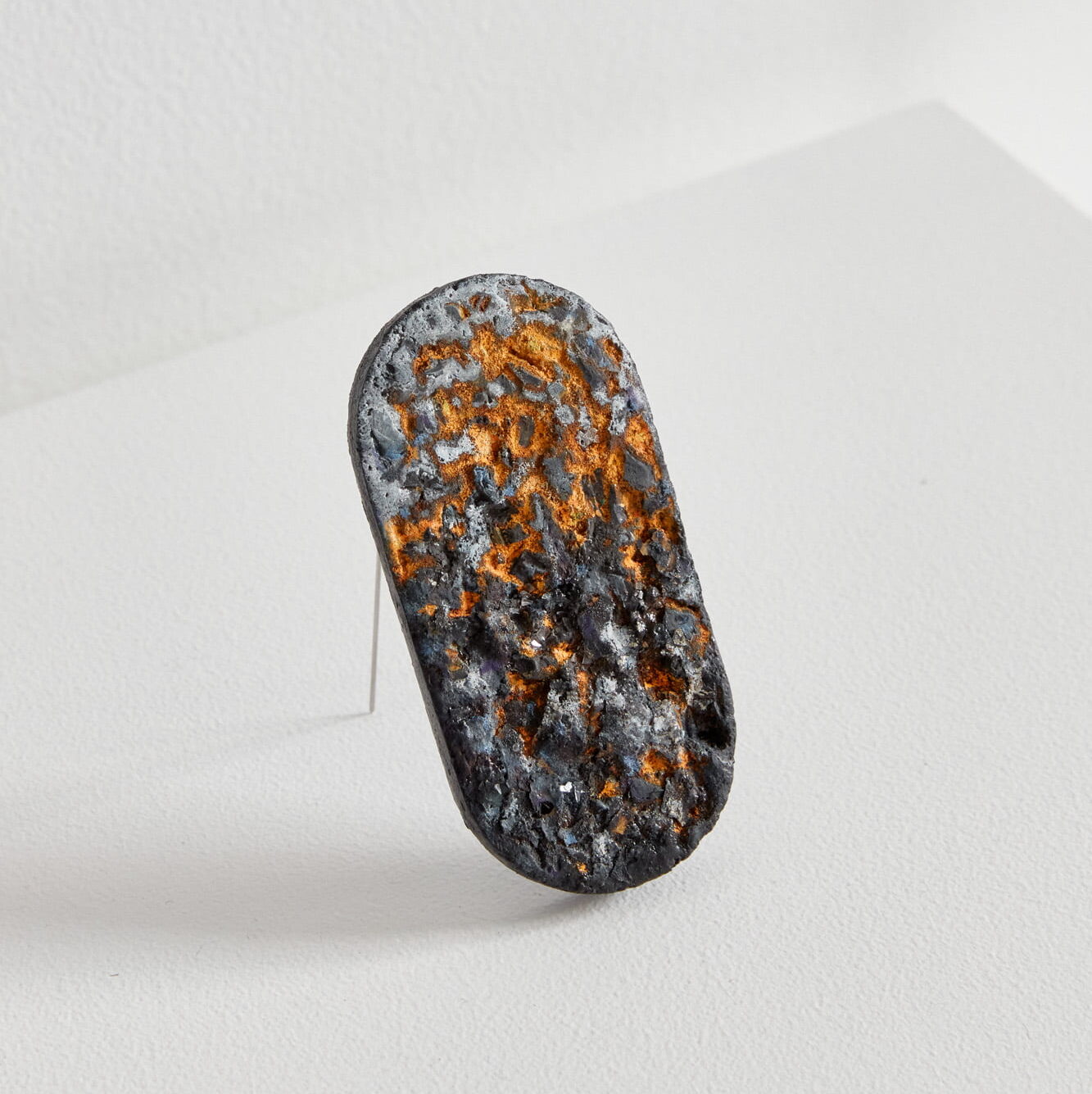
Inari’s often industrially produced materials include concrete, aluminium, lead, steel, glass, found locally foraged objects and discarded matter, and plastic price tags. They echo an urban environment whilst imparting stories of her enmeshment in natural landscapes, or her experience of how the raw natural world grows through the spaces and fissures in our humanly synthesised labyrinths. Beauty and a sense of wonder pass through and between both these realms. As the gentle revelation of afternoon sunlight bathes asphalt with its warmth, an angle of incidence renders the road a miracle, with the dazzling glint of quartz floating on the dark depth of bitumen like the void of night. In Inari’s signature concrete brooches, she infuses concrete with an atmospheric mood, using pigment and gleaming accents of glass and other substances, to create pools of textural and light refracting detail, portals of wonderment.
These humanly synthesised materials are not borne of natural processes energised with an established ongoing organic momentum, as found in the raw biotic world, but out of human will and design—for a ‘purpose’. And if you can say that behind these human imperatives also lie raw, natural energies, it’s true, but perhaps slower organic life processes can adjust to a broader biological poetic. They are relational and listen as they grow, they embody a temporal rhythm that allows them to do so. This is what Inari brings to her work with industrial and domestic materials—a poetic that resonates with the energies and structures of the natural world through the language of our built material one. They start to unite with something beyond themselves. The bath mat sits alone on the floor, it has one purpose, but when carefully soaked with wax and gilded with pigment again and again through a loving, lacquering process, the textile rises and takes other forms that suggest tree trunks, seasoned bark, or the legs of animals [‘Keväthäät (February marries March)’]. In this way Inari is like light, the sort of light that reveals the miracles in commonplace things. ‘A certain slant of light’ (2) as the poet Emily Dickinson might say, though Dickinson spoke of a deep melancholy that comes with a particular quality of light in the late afternoon, what Inari cultivates and foregrounds is a deeply felt wonder and joy.
It may have taken Inari this many years to re-connect with what she calls ‘Original Joy’, but of course this joy is different to what it was in those early years of life. It is imbued with the strains and richness of time, and I think this makes it ever stronger, because it comes with a consciousness of its value. The works you see that have evolved from this place are fed by a great sensitivity to the minutiae of moments, the intricate details of light, texture and atmosphere, but they are simultaneously shaped by a pulling back of perspective that encompasses their interplay and transformation across seasonal time. This portraiture of a changing seasonal landscape seems to me to mirror Inari’s own evolution, and the way periods of transformation, and maturity, allow us a view of those greater arcs of personal narrative in our own lives.
It also speaks of the alchemical way we are enmeshed with our histories and environments, where the passing of perceptions, energies and artmaking flow without boundaries.
Dr Michaela Pegum,
July 2026, Preston, Victoria
1. Popova M (2026) Spell Against Indifference: A Poem, The Marginalian website.
https://www.themarginalian.org/2023/08/20/spell-against-indifference/
2. Dickinson E (2016) The Collected Poems of Emily Dickinson, 1st edn, First Avenue Editions, a division of Lerner Publishing Group, Minneapolis, MN.

Work from Original Joy
 Artist with 'Koivu', Photos by Katja Immonen / Fred Kroh
 Installation, Photo by Andrew Curtis
 Installation, Photo by Andrew Curtis
 Installation, Photo by Andrew Curtis
 Installation, Photo by Andrew Curtis
 Installation, Photo by Andrew Curtis
 Installation, Photo by Andrew Curtis
 Installation, Photo by Andrew Curtis
 Installation, Photo by Andrew Curtis
 Installation, Photo by Andrew Curtis
 Installation, Photo by Andrew Curtis
 Installation, Photo by Andrew Curtis
 Installation, Photo by Andrew Curtis