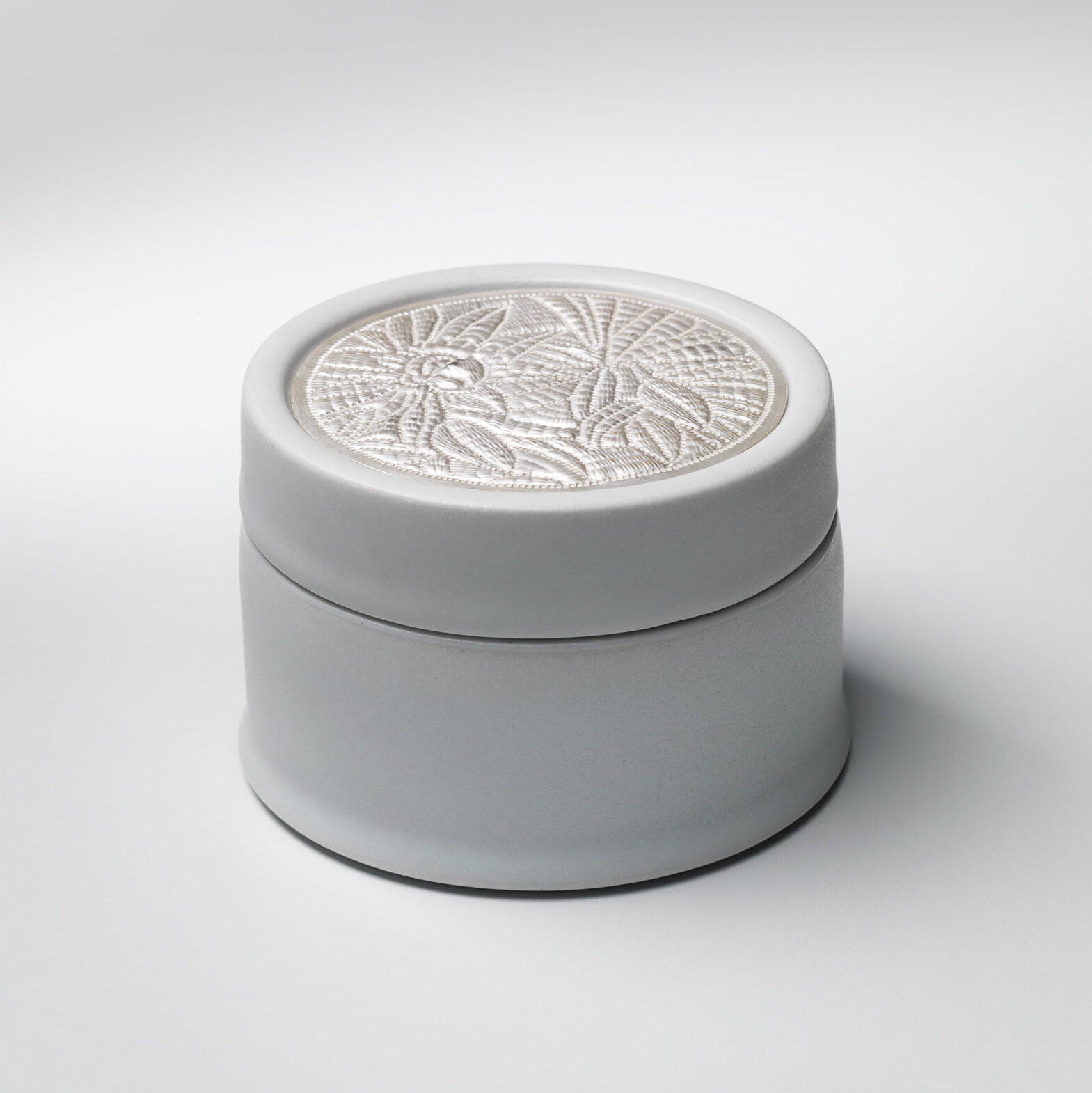
Silver is the Moon
Julie Blyfield has always worked with silver: sometimes palely shining, sometimes oxidised to black, always wrought with formidable skill. In India, though, during her first visit to the sub-continent in January 2025, Blyfield came to see silver with fresh eyes. How could she not, amidst the extraordinary cultural energies of the place?
There, silver means the moon. It is said to be derived from the tears of the great Lord Shiva, and is associated with the goddess Lakshmi, who guarantees prosperity. There, silver carries spiritual significance, with connotations of purity and, when worn, health bestowed by the moon’s cooling properties. Blyfield tells me that the Hindi word for moon is chandra, while silver is chandi, the sources of the two words etymologically linked. It was a revelation.
In India silver is everywhere. It appears in myriad forms in jewellery worn at all levels of society, and as decoration on festive clothing, but it is also important in Mughal palaces and gardens, in architectural decorations in Rajasthan, and embroidered into brilliant textiles in Gujarat. The mirrored walls of great palace interiors reflect silver’s benediction, and, crucially, many of these decorations are floral, one Indian inheritance of the great Persian traditions of the garden as Paradise on earth. So everywhere in north India Blyfield found flowers beloved of painters: lotus, iris, geranium, an orchid, many varieties of leaves. And she has borrowed them for necklaces that resemble garlands, including one plated in gold, for single leaf earrings, and for brooches that set plants into diminutive frames. (A few are inlaid with fragments of mirror.)
Which brings us to the question of cultural framing. We know Julie Blyfield is an assiduous student of nature; she has roamed Australian deserts, seeking the continent’s remarkable flora in situ. But it’s also worth remembering that her previous work with Australian flowers, grasses, even those magnificent seaweeds, drew not only on direct observation, but also on artistic and scientific representations: botanical illustration with its particular protocols, and her own photographs, as well as historical forms such as mourning jewellery. In short, the artist’s eye sees through the frames of many forms of understanding.
In India, Blyfield encountered floral and vegetal patterns everywhere: making and meaning inextricably connected. She has borrowed forms and ideas from textiles, for example, such as block printed fabrics with their insistent repetitions, and, importantly, from architectural decoration: that explains her use of the quatrefoil form for earrings, and as brooch frames supporting delicate maple, acanthus and lotus leaves. The quatrefoil is found on pietra dura decoration, inlaid coloured stone embellishment that came to India with Italian artisans and became localised as parchin kari; it is one of the glories of the Taj Mahal.
One image crosses many cultural boundaries: the Tree of Life. Each of Julie Blyfield’s wall pieces takes a beloved plant and makes it over into her own tribute to the regenerative power of this beautiful image. A tree, standing tall and leafy and comely. A celebration of life, and a commitment.
Julie Ewington